

The greatest joy and honor of my life is being a Black woman and so naturally it took me weeks that almost felt like months (in a good way) to articulate just how exquisitely visceral, raw, real, and personal IS GOD IS truly is for me. I made it a point to take my time to sit and stew over Aleshea Harris's (On Sugarland) brilliant and bold play-turned-transformative on-screen adaptation I witnessed. Harris being able to write and direct this film after crafting the subtle complexities for the stage means so much for Black creatives like myself. The result is what I would consider one of the greatest bodies of work that I will witness this year, and I do not say that lightly. This film is the kind of art that sits with you well after you have consumed it, and I had the privilege of picking up on cultural nuances that are so seamlessly woven throughout, well after it ended.
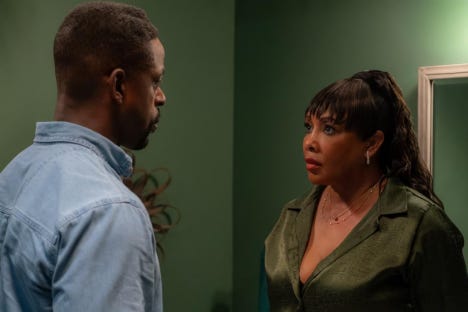
IS GOD IS breathes at the intersection of retribution, forgiveness, rage, and unapologetic Blackness in every single frame and form. The performances are equal parts compelling, profound, heartbreaking, and exceptional. And while we hate his character, the Monster, Sterling K. Brown (Paradise) is still very much serving a villain we never knew he could portray. This is not about his profound acting range but more about how, because he is one of the kindest actors in Hollywood, I could’ve never predicted he’d be so nefarious. His ability to ignite fear mixed with just enough charm and manipulation to make viewers question his vile acts for a split second makes Brown downright despicable in this role, and I truly cannot imagine another actor in it.
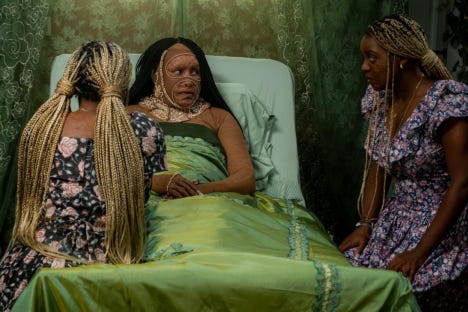
Kara Young (I'm a Virgo) as Racine the Rough One and Mallori Johnson (Kindred) as Anaia the Quiet One are perfectly cast as the twins who take on the gargantuan task from their mother, Ruby the God (Vivica A. Fox, Kill Bill), to kill their father, the Monster. Shoutout to Ms. Fox, because to see her in all of her on-screen glory truly felt like Harris honoring her and her vast contributions to cinema, particularly in the early days of her career. Watching the scene of Ruby the God getting her hair braided by all of those Black women — honoring her in life but also giving her such a thoughtful and respectful level of care in her final moments before she transitions — was something to behold. It also spoke volumes in its duality with the very thick air of wrath that she held for their father, but joy as a mother who finally gets to see her babies again. This moment in the film specifically felt like a mirror to Fox's career, which shaped so much of the media I grew up enjoying and the very pivotal Black films and television shows that transformed my love of the arts into a career in them. Her performance, while short, is wildly impactful to the physical and emotional journey that Racine and Anaia go on. And for just a moment in the film, Racine and Anaia have their innocence restored by their reunion with their mother, able to soften even just for a moment and gain the security, protection, and childlike ease that they've been missing for years.
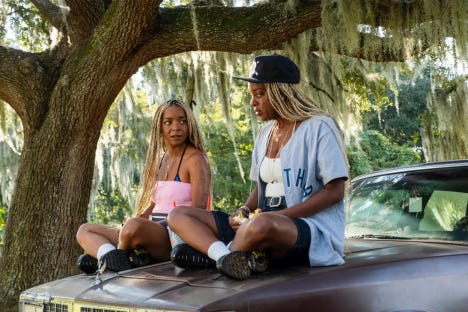
While Anaia is hesitant to go forth on this path, Racine is ready and not considering the consequences that lie ahead. I spoke with Harris about the choice to imply the violence rather than overtly show it, so as not to add more Black trauma onscreen. It is that deliberate choice that implores audiences to look beyond what is right in front of them and usher in more thoughts about how we can and should protect Black women, which is one of the reasons why I love this film. Yes, there is just fury at the center, and there should be, because these two Black girls had gone unprotected for so much of their lives. It started with their father, the man who literally had a hand in bringing them into this world, scarring them quite literally and disappointing them in more ways than one. After thinking their mother had passed away, they went into the foster care system, and every single family they were placed with abused and harmed them in some way. Racine and Anaia recognized very quickly that the only people they could trust were each other. That's why this charge is so difficult — because it's the first time we see them torn about how to approach the situation and, at times, even the morality of it.
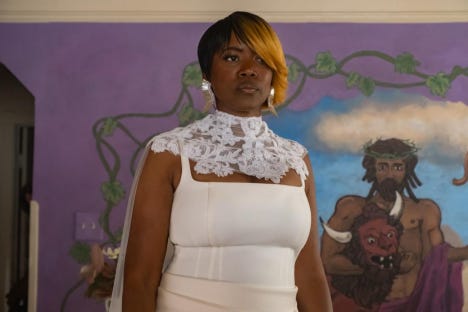
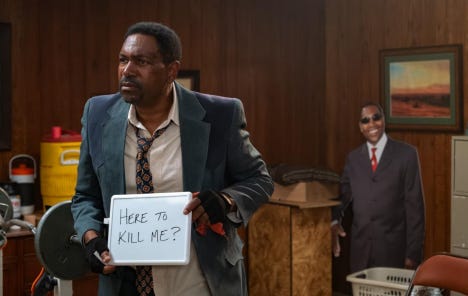
On their road trip to find the Monster, they stop at a church. They encounter Divine the Healer (Erika Alexander, The Fall and Rise of Reggie Dinkins), who is clearly still delusionally in love with the Monster. She and her son Ezekiel are awaiting his return. When Ezekiel encounters his sisters and their plan, he makes it his mission to let nothing harm his dad. The idolatry that Divine and Ezekiel exhibit when it comes to the Monster is wild to see, particularly when he abandoned them and has left them with years of false hope. So when Ezekiel attempts to kill his sisters, it’s shocking, because it is lost on him that the Monster is an awful father to him as well and an even worse man. When they make it to lawyer Chuck Hall (Mykelti Williamson, Forrest Gump), they get a clear picture of the Monster’s true wrath. Having had his tongue extracted so that he couldn’t snitch, Hall prepared for the worst by training for the day he knew the Monster would return to finish the job. Hall, trying to pay his penance for his role in the destruction of Ruby’s, Racine’s, and Anaia’s lives, provides them with the address they need to find the Monster.
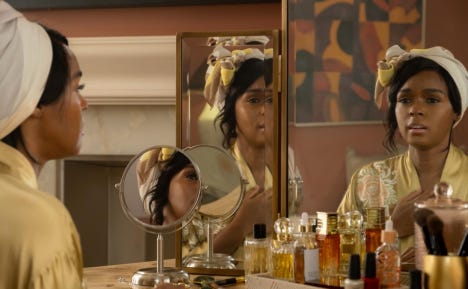
On Racine and Anaia’s journey to the Monster’s home, which they’re sure will also contain the twin sons Hall warned them about — Scotch (Xavier Mills, Forever) and Riley (Justen Ross, Fight Night: The Million Dollar Heist) — they have a run-in with the Monster’s wife and the twins’ mother, Angie (Janelle Monáe, Hidden Figures). The audience has just witnessed Angie frantically gathering her items for a robust escape from the home while the Monster is away. She is fed up, and while we don’t see all of the abuse and trauma against her at the hands of the Monster, we know exactly why she’s leaving everything she knows behind. The house is beautiful; it’s clear that they are financially well off. When Anaia and Racine see this, it’s clear they’re thinking about their lives compared to their brothers’. Their brothers seem to have it all — but at what cost? When Racine and Anaia confront a fleeing Angie, they want answers and insist that she knew they were alive. Angie insists she only knows what she was told, and it is hard to know if that’s the truth or the lie she told herself to keep the guilt at bay.
There is such empathy for Angie, because you know the absolute hell she’s had to go through being married to the Monster — the hell that led her to this point of leaving her sons behind in a calculated escape — but there’s also a point of anger as a viewer when she tells the twins that their mother should’ve done more. It’s the duality in this exchange that shows Harris’s brilliance in conveying two sentiments at once that evoke a host of emotions for the audience. It’s that victim-blaming — from another victim, no less — that sends Racine into a spiral. It’s the first time she kills, and something in her shifts. Defending her mother’s honor unleashes a new form of ire in Racine, one that makes her unrecognizable to Anaia, and that is problematic.
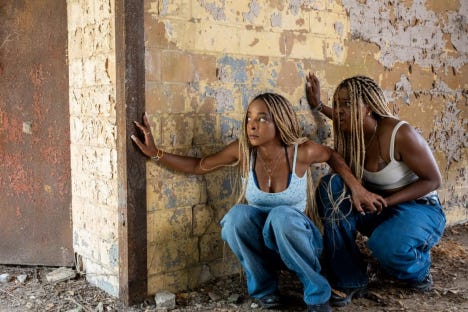
So when they meet Scotch and Riley under the guise of being strippers — a gift from their father for their birthday — they see clear signs of the misogynistic madness that the Monster passed down to Scotch. After Anaia reveals to Racine that she’s pregnant, something Ruby had picked up on and hinted at in her meeting with her, Racine decides then and there that all the men have to die. Scotch is brash, rude, and even domineering over what appears to be a more tender-hearted Riley. When Racine gets Scotch alone, she kills him, knowing this will surely set the Monster off upon his return. But it’s the shock of seeing his brother murdered that unlocks Riley’s violent nature, and in an attempt to right this wrong done to him, he tries to kill Racine and Anaia. Anaia tries to calm him but quickly realizes there is no reasoning with him. She is forced to kill Riley, thinking Racine is dead too — but most importantly, she has to save herself and her unborn child.
Of course, in the midst of this, the Monster returns home for the day. As this concludes the road trip and the mission, Harris layers the fear even more. When the Monster doesn’t find Angie and is instead greeted with the bodies of his dead sons, he knows exactly who has come for him. It’s in this moment, when Anaia is reunited with the Monster, that he tries to charm her with the grandfather angle, knowing that his rampage and agenda will always be to continue to harm her and all of the women in his orbit. In a brilliant cinematic moment, just when Anaia needs her the most, twin telepathy kicks in and Racine rises back from unconsciousness to help her sister. She ends up losing her life, but the Monster is dead, and Anaia and the baby are safe.
In the final images, Anaia is seen holding her daughter — born unto a man who didn’t have the decency to fully see and love her for all she is, scars and all — but out of that relationship that is clearly not for her, she gets the gift of a daughter. After losing her other half in Racine, it feels like God’s gift back to her tenfold for all she lost: her childhood, her innocence, her life with her mother, her protection, her physical body, and so much more. The majority of the men in this film make a point of protecting the Monster in some sort of way, buying into this narcissistic, hyper-masculine, patriarchal nonsense.
This film works for a plethora of reasons, but its core lies in how wonderfully balanced and in tandem Racine and Anaia are. They are only able to be their full selves with each other, and the only layer of protection they have is each other. It was heartbreaking to watch Racine’s tragic yet heroic end. And while seeing her father and soulmate of a sister die so heinously was devastating, I know Anaia still felt a bit of bittersweet peace knowing the threat of the Monster looming over her is no more.
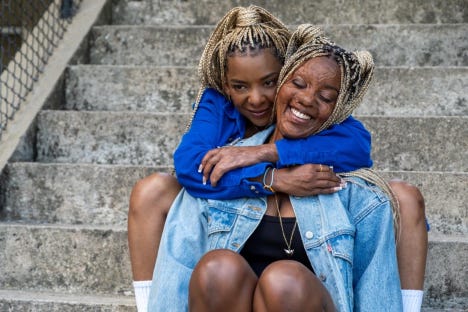
I’m so glad for all parts of this film because Harris made it just so beautifully Black and so superbly rich in its textures, tones, and colors. I watched it with so much pride as a Black woman, seeing us reflected in the totality of who we are and a small portion of some of our community’s lived experiences. Black women are expected too often to take the high road. We’re expected to live with the hurt and trauma bestowed upon us by the world — and even those closest to us — with closed mouths. This film pushes back on that narrative and shows Racine and Anaia rightfully going after the justice they deserved, having been failed consistently at the hands of and supremely disappointed by the Black men who were supposed to protect them — which holds true for a lot of Black women on and off screen. Black women have historically been the most unprotected group, and the message of this film for me was: the protection of young Black girls and ultimately Black women is vital and can and will unlock a level of healing, joy, freedom, and peace that we deserve. Racine and Anaia had to provide that for each other when everyone else failed them. And their story isn’t abnormal, because nobody has had my back, or really any other Black woman’s back, like another Black woman. And that is from top to bottom, through and through, forever and ever. So, brava Aleshea Harris, and you will always have my support for IS GOD IS.
